Stuffed Chicken Breast with Chicken Gravy
On Wednesday we talked about jointing a chicken. Here's an idea. Why not get two, or even three? While you can get a meal for a few people out of two chicken breasts, if you restrict yourself to cooking just wings or drumsticks, then two of each won't take you far, even for just a couple. We'll develop that theme, but the subtitle to today's text is-
Fun With A Chicken Part 1: Breast Meat
 I bought a whole chicken. Not an unusual purchase, but I buy the more expensive ones in the hope that they will have lived better lives than their sad, battery reared cousins.
Roasting the chook is our go to. If you are new to this, it’s important to ignore the cooking times which they will give you on supermarket wrapping. Unless, that is, dining on cotton wool is your thing. At 190˚C I am now reckoning that 15 minutes to the pound (0.454 kg) plus 15 over is enough. Many of the books stipulate 20 + 20. I have yet to encounter a bird which needed more than 90 minutes. But guess no more. Get yourself a meat thermometer. Anything over 70˚C is well and truly cooked, possibly overly so.
But today I jointed the beast, as per Wednesday's instructions, and have 8 pieces ready to go. (And as you all passed your arithmetic tests that might be 16 or even 24.) So I decided to be a little more interesting, but with no more inspiration than the contents of a not very full fridge. Some black pud, some bacon, a pack of mushrooms, that was it.
I’ve cooked stuffed chicken breasts wrapped in bacon many times. It’s usually the porky bit which lets you down - greasy or over salted. Paying for good stuff is seldom money wasted. The best to be had these days comes from our good pals at Castle Game.
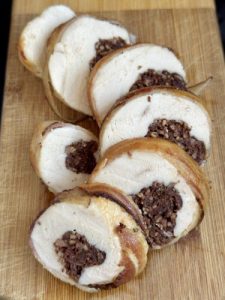
Stuffed Chicken Breast with Chicken Gravy
Ingredients (Serves 2)
For the breasts
2 chicken breasts; 1 round of good black pudding, skinned and cut into slices approx. 1cm wide; good quality bacon to wrap – about 2 rashers per breast; olive oil.
For the gravy
1 chicken wing, cut into three pieces; ½ onion, roughly chopped; 2 small carrots, roughly chopped; 150ml dry white wine; 150ml good chicken stock (see below); 1 bay leaf; 2 sprigs of fresh thyme or a sprinkle of dried thyme; olive oil; generous knob of butter; s & p.
************************************************
Prepare the chicken first. Trim any fat or tissue from the breasts. Remove the thin strands of meat. Some call these the faux-filets: I refer to them as chef’s perks. Read on.
With a thin knife, starting at the fattest part of the fillet, looking lengthways, cut a pocket and widen it as best you can without piercing the rest of the flesh. (Truth be told, if you are stuffing with something like black pud or haggis, a hole is less vital; however, if you’re using something liquid such as pesto it’s rather more important.)
Push the slices of black pud as far down the holes as you can. Seal the hole with a little plug of the faux-filet. Wrap each breast in a couple of slices of bacon, and hold them in place with a couple of cocktail sticks. I tend to refrigerate for a couple of hours. With the black pud version, that's less important, but if you're using a liquid stuffing, or a flavoured butter, it's essential. You may note that I haven't seasoned. You'll get enough salt from the bacon, and plenty of flavour from the black pudding.
Get on with your gravy. When roasting meat, you have the pan juices to get things interesting. Here you have to improvise. I probably haven't learned a huge amount from cooking programmes, but I saw Michel Roux doing something similar for a lamb gravy. To get the flavour he had kept some end bits from his meat. Here I used one of the wings. Leave the skin on - you can skim off the scum later.
Over a fairly high heat cook the onion and carrot for a few minutes then chuck in the chicken wing bits. You want them to brown but not burn - always a tricky compromise. Pour in the wine and the herbs. Bubble till the liquid has reduced by a half. Add the stock and reduce again. Again you may have noted that no other seasoning has been added. Add salt before reducing a liquid and you'll end up with brine.
Once it is down to half again, strain the liquid and set aside. You are looking eventually to end up with just a few spoonfuls of gravy, with no flour involved. As it cools there will be some scum on top. Remove with a slotted spoon and/or kitchen paper. Bring back to the boil, add a generous knob of butter and reduce again. Taste. Then, and only then, add a little salt and pepper if you like. I think I added more butter towards the end.
Get it to the consistency you like. I'm not a big gravy fan, but my fellow diner was pleased to see it. Now for the main event.
To cook the chicken breasts
Preheat your oven to 180˚C. In an oven proof frying pan, brown the chicken parcels on both sides then put in the oven. If you don't have a frying pan which can go in the oven (why not?) transfer to a preheated roasting tin. Cook for about 8 - 10 minutes (but see below).
This is where the wonders of a thermometer come in. In the past I have tended to overcook these, because no one likes pink chicken. After 8 minutes the smaller one was spot on, but the larger one needed another 90 seconds. End result - perfect and (everyone's favourite adjective) moist.
Oh, the faux-filets? A snack for the cook. Cut into small pieces and fry in butter and oil with a little salt. I even shared my perks with my fellow diner. That's love for you.
Chicken Stock
This is simplicity itself. Recipes from chefs trained in the French tradition will have you add carrot, leek, celery, peppercorns and the like. That will give you a stock relevant to that cuisine. I went on a day course at the (now defunct) Martin Wishart cookery school. The recommendation there was that you should make a basic neutral stock to which aromatics and seasoning can be added later to suit the recipe. In an ideal world you would use a couple of chicken carcasses and trimmings. This would make a good quantity which you can freeze in smaller quantities.
Ingredients
Chicken bones and trimmings; water.
************************************************
When jointing the chicken (see Wednesday's column) reserve the feet, trimmings and excess skin. Rinse the carcasse to remove any blood, then break it up. Add just enough cold water to cover completely. Very gradually bring to a simmer. If you allow the liquid to boil, the fat will dissolve, giving you an opaque and fatty stock. Adjust the heat so just a few bubbles are appearing. Cover and cook for two hours.
Some books will tell you to skim the fat. I have never been able to do this effectively with hot liquid. Instead, allow to cool, cover and refrigerate overnight. The fat will obligingly solidify on the top and may easily be removed. Stock freezes well. If you have spare capacity you could use an ice cube tray or two. So much better than stock cubes or pots.