Onion Tarts with Puff Pastry
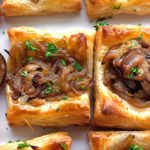 A winter resolution is to improve my pastry work. Making it (I'm talking about shortcrust here) is simple enough. It's just that my rolling skills leave much to be desired. My ma's version produced wonderful crisp stuff. Her recipe is described as being extremely short, whatever that means*. As a result, combined with my inept use of a rolling pin, mine has a tendency to fall to bits. Mum, on the other hand, didn't even possess a rolling pin. A glass milk bottle sufficed for her, the pastry gliding into place at will, Mary Berry style. I suppose that's called talent.
Anyway, help is at hand in the shape of store bought puff pastry which even comes ready rolled. Not even I can botch that up. And what shall we put on our pastry? Well, after Wednesday's article, only one answer: onions. Onion tarts are things of loveliness, and you have so many options. Great for little canapes (remember to let them cool a bit before you serve), or for a large one to put on the table for an informal lunch.
The Basic Pastry Technique
It's pretty much the same, regardless of size: just the cooking times will vary a little. The edge has to be golden brown. For larger ones I'd put the pastry on a pre heated baking sheet to avoid the dreaded soggy bottom.
With the point of a knife create a border. By that I mean you draw a square or rectangle on your dough, leaving 1 - 2cm at the edge. Draw a line, but be careful not to cut through. With a fork, make a series of pricks inside the square. Again, be careful not to go right through. Glaze the edge with beaten egg. Put your filling on the square and cook at 180˚C/Mark 4 for about 18 - 20 minutes until golden brown. Keep an eye on it during the last five minutes. Ovens do vary (my new one is, I suspect, too hot) and you don't want black pastry.
The Filling
Well, onions, of course. Refresh your memory from the Fifty Ways to Fry Your Onion article and decide how you're going to proceed. For this recipe the important thing is that your filling isn't liquid, otherwise it'll simply slide off. Doh! If you were using little tartlet cases, onions simply sweated, perfumed with some garlic and perhaps enriched with a smidgeon of cream, would provide a delicious morsel.
Today, however, I suggest you want to go down the caramelisation road. This will need 30 - 60 minutes of patience.
Don't forget to season. If you are making, for example, a curry, the seasoning will come later. Not here. Salt and pepper, obviously. Thyme is a classic combo with onions. Dried is sometimes handier, as it can be difficult to see the stalks and get them out when it's cooked. Or, if you can be bothered, remove the leaves from the stalks before you start. And what harm could a splash of Balsamic vinegar ever do to an onion? Or Lea and Perrins? Or even soy sauce, but be careful with the salt.
Extras
Some recipes suggest a thin layer of Dijon mustard on the base. Or you can have toppings. One recipe which I saw suggested a combination of breadcrumbs, grated Parmesan and thyme leaves.
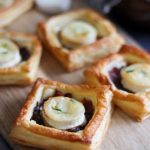 What about dottles of goat's cheese? They go particularly well if you have used red onions, or have slightly cheated by adding a little sugar to the onions while they were cooking. Not classical, but I don't care. They're your tarts.
Want to go Mediterranean? Salted anchovy fillets and black olives. Voilà! You have a pissaladiere.
You get the picture. Have fun playing around, but remember that classics are so called for a reason. Doing my researches I came on one with a suggestion of hot honey, and moved swiftly on. If you invent any decent variations, let me know.
*Actually, I do know what short means. Don't write in. It means a high fat to flour ratio, resulting in a crumbly, melt in the mouth texture - and also more difficult to roll.