Cream Thoughts
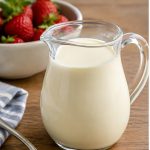 Single versus double; sour; fresh; sweet and heavy; clotted. Oh, and buttermilk. Have you ever paused to give any of these a moment's thought? And if so, have you found yourself confused?
It may seem an odd topic for today's article, given that L has an allergy/intolerance. (Would someone with the appropriate knowledge remind me of the difference?) And truth be told, I have no idea how it came to mind, but that's not unusual. I suppose the questions which have to be asked are, how rich do you want it, how sharp do you want it, and what will you do with it?
Experienced cooks - that's most of you - will have been using some or all of these ingredients for years, and know what you're doing. Is that by instinct, or by the appliance of science? As ever, skip this if you know it all, but perhaps pass on to your young, or to anyone taking the early culinary steps.
Single or double is a question which almost answers itself. I don't think I'd ever use single cream. I have no desire to pour it over anything. You can't whip it up, and in cooking it's much more likely to split. The double stuff is much more robust and can cope with a good bubble; however when cooking with cream of whatever type, it's generally wiser to add a little at the end.
Be aware that milk is an emulsion of fat droplets and water. Extraordinary to think it's produced by animals which live off a diet of grass. The fat is less dense than the liquid and gradually rises to the surface. Those of us of a certain age will remember fighting over who would get the top of the milk, the creamy section just under the milk bottle cap. I have no idea why that no longer happens. A lot happens between the cow and the supermarket, certainly when it comes to cream.
Centrifuges are involved. The difference between single and double is the fat content, about 18% and 48% respectively. Heavy cream? Simply the US term for double. I've also seen some transatlantic writers use the term sweet cream. Not entirely sure what that means, but cream is not inherently sweet.
But it can be sharp. Sour cream has nothing to do with sour milk, ie the stuff that's gone off. The sour flavour comes from fermentation or acidification. I believe they inoculate it with lactic acid bacteria. Getting a bit too technical for me. So where does crème fraîche come into the equation? Actually the twain are quite similar in some ways. You get no points for guessing that it developed in France. Sour cream on the other hand is more closely associated with the US. Differences? The tang of crème fraîche is milder and it has a higher fat content, 30 - 40% as opposed to 18 - 20%.
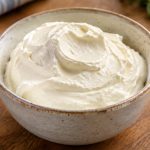
Whipped not Clotted
Then I got to thinking, what on earth is clotted cream? Is it just whipped up to make it thick? Nope. It involves a gentle heating of full fat milk for several hours, allowing it to cool, and skimming off the thick layer of cream on the surface. (How do you prepare your scones in a cream tea? I'd be on the Cornish team. Jam first. If I were ever to eat a scone, that is.)
And I had to go and confuse things further by mentioning buttermilk. Yes, it is traditionally the liquid left over after making butter. Or was. Don't confuse that with whey, which comes from cheese making. And you'll note my use of the word traditionally. That's because modern commercial buttermilk is generally made by adding selected lactic acid bacteria to milk.
Buttermilk has a consistency somewhere between milk and thin yoghurt. It's beyond the scope of today's article to talk about its uses, but it's much more widespread in the States. Marinading chicken before frying; making (American style) biscuits; pancakes.
I knew that it was an ingredient in Irish soda bread, but for years I couldn't work out how you could produce a non flat bread with an acidy dairy product but without a raising agent. Another ingredient is bicarbonate of soda, but I really didn't know what that was either. Then I read the explanation. Bicarbonate of soda + acid → carbon dioxide gas. And there was me thinking it had something to do with the fairies or the little people. Science is very useful, but it can take the fun out of things.
A very enjoyable read. Bringing back memories of a grumpy maiden aunt staying & my dad giving me the top o’ the milk on my porridge, as usual, & her being affronted 😂
Thanks, Wendy. My wife thought it was an odd article. Then again, give her a spoonful of the stuff and projectile vomiting ensues rather quickly.
Single cream does have its (limited) uses. For instance, when doing Mussels Marinière, I find single cream more suitable, as I like a mountain of the lovely molluscs in my bowl and plenty of resulting ‘soup’ to be mopped up with chunks of freshly baked white roll, and with double cream it could be a bit too filling and somewhat unfriendly towards one’s hard-as-it-is working liver etc. Having said that, one can always make single cream by diluting double one with milk or water, but not the other way round.
Good point; however, I would never add cream to a mussel dish. But if I’m doing, say a vermouth or white wine based sauce for fish I might add a smidgen. If it was for my wife I’d use Elmlea. Not sure anyone would notice the difference.
In the US, what is called heavy whipping cream must have a minimum of 36% butterfat, and I’ve never heard of one over 40%. So the British double cream is something special! I make my own clotted cream because a store-bought version imported from the UK is not available in the regular grocery stores. Like you, I never use single cream, in US called half-and-half with butterfat percentage anywhere between 10.5 and 18. Love your writing, Tom!
Thanks, Jean. Much appreciated.