Why You Really Should Have a Meat Thermometer
 Unless, of course, you're a vegetarian. But in that case you're probably not reading this. But if you're pescetarian it's relevant for fish too.
It occurred to me that in my last few articles on the subject of chicken I've been banging on a bit about cooking temperatures and extolling the use of a food thermometer, without really clarifying why this will make such a difference to your meat cookery. The aim is to save you from the misery of dried out chicken and overcooked pork. Let's try and distinguish between food safety and eating quality. Note that I'm talking about cooking meat in muscle form, ie roasts, steaks, chops, etc. Burgers, sausages and meatballs require different treatment.
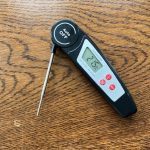
So you've acquired your thermometer? As I write, available for under a tenner on Amazon. Make sure you get one with an physical probe which you can insert into the meat. An infrared one won't measure internal temperature. So how do you use it? Insert into the centre of the thickest part, avoiding bone and large areas of fat. Leave for a few seconds until the temperature stabilises. The thermometer doesn't tell you when to stop cooking, it just tells you when to stop guessing.
Let's look at some myths about meat thermometers, and cooking.
You don't need one if you're an experienced cook.
Not so - even chefs use them. Yes, I can generally tell by touch if a steak is done to my liking, but I get it wrong from time to time. With my last oven I could trust it to roast a piece of beef by time; however, the new oven seems a little hotter. Also if you're cooking a different cut of meat, why guess, given today's prices?
Pink meat is unsafe
Pink chicken, yes, but with anything else that's nonsense. Pork has probably suffered more than any other from this. Once upon a time there was a fear that you could get tapeworm unless pork was cooked to a frazzle. Food hygiene standards in the UK and EU are such that there is no possibility of this. The great Spanish chef Jose Pizarro and his compatriot Paco Romano at Tapa, Edinburgh are slowly winning the battle to inform diners that slightly pink pork is an improvement.
A bird is cooked if the juices run clear
This is one of the worst tests ever. Don't rely on it.
In a recent recipe for chicken breast you said that 70˚C was OK, but Food Standards Scotland say 75˚C. What makes you think you know better?
It's back to food safety versus eating quality. Governments err on the side of caution. The rules are there to avoid the risk of infection from bacteria. But bacteria die according to both temperature and time. At 75˚C food is pasteurised immediately. But if food is at 70˚C for just a few seconds, that has the same effect. Bacteria will be on the surface. As chicken has a large cavity, that too has to be considered. With a chunk of beef or venison or lamb, it's just the surface you have to be concerned about. We're measuring internal temperature. Beef will be seared on the outside or cooked in a hot oven. That's why it's perfectly safe to serve most meats rare or medium rare.
So what temperatures are we looking at?
Well, if you were to serve beef at 75˚C, not only would it be "well done" it would be ruined. For medium rare for most red meat, anywhere around the 55˚C mark is fine. But, and it's a big but, that's the final core temperature. You wouldn't dream of serving meat without allowing to rest. No, please tell me you wouldn't. That applies equally to steak as to a roast. There is no such thing as a nice juicy steak. That would mean that you haven't allowed it to rest.
Resting Meat and Carry Over Cooking
Resting allows the muscle fibres to relax and the juices to be retained. The ideal resting time is about 50% of the time it took to cook. With larger pieces cover them in foil to keep them warm. Most fish doesn't require to rest, as thin fillets will dry out quickly, though thick or fatty cuts like salmon, monkfish or tuna will benefit from a couple of minutes.
While the meat is resting, even out of the oven, it is continuing to cook. This is known as carry-over cooking. Typical carry over temperatures are approximately 1-2˚C for a thin steak; 3-5˚C for a thick one; 4-6˚C for a small roast; 5-8˚C for a large one, and up to 10˚C for a whole turkey. So if you're aiming for beautifully medium rare roast beef, removing it from the oven at around 50-52˚C is often about right.
Why are burgers etc different?
We've learned that bacteria are on the outside; however, burgers, sausages and meatballs are made from meat which has been minced up. In other words, there could be bacteria anywhere. Make sure they're cooked through to at least 70˚C.
Why do you say that supermarket guidance for cooking chickens is wrong?
Because they are terrified someone might sue. The instructions are intended to be fool proof rather than optimal, to eliminate the risk of any undercooking. They have to allow for-
- inaccurate domestic ovens (some can have a temperature difference of up to 20˚C from the stated setting)
- chickens which are put in the oven straight from the fridge
- cooks who don't allow the bird to rest after cooking, and
- people who don't use a meat thermometer
None of which, of course, applies to any of you.
Core Temperature Chart
The following might be useful for future reference.
| Meat | Rare | Medium Rare | Medium | Medium Well | Well Done | ||
| Beef (steaks, roasting joints) | 50–52°C | 54–56°C | 58–60°C | 63–66°C | 70°C+ | ||
| Lamb | 52–54°C | 56–58°C | 60–63°C | 65–68°C | 70°C+ | ||
| Venison | 48–50°C | 52–54°C | 56–58°C | 60°C | 65°C+ | ||
| Duck breast | 54–56°C | 57–59°C | 60–62°C | — | 65°C | ||
| Pork loin, chops, fillet | — | 60–62°C | 63–65°C | 68°C | 70°C+ | ||
| Pork shoulder (sliced) | — | — | 68–72°C | — | — | ||
| Pulled pork | — | — | — | — | 90–96°C | ||
| Chicken breast | — | — | 72–74°C | — | 75°C | ||
| Chicken thighs | — | — | 74–76°C | — | 78–82°C | ||
| Turkey breast | — | — | 72–74°C | — | 75°C | ||
| Turkey leg | — | — | 78–82°C | — | 82°C+ | ||
| Fish | Ideal Core Temperature | ||||||
| Salmon (slightly translucent) | 46–49°C | ||||||
| Salmon (firm) | 52–55°C | ||||||
| White fish | 52–55°C | ||||||
| Tuna (rare) | 42–46°C | ||||||
| Tuna (medium) | 50–52°C | ||||||
A Dairy Story
 L and I were at the pictures last night. On a Tuesday? Did a meerkat discount have anything to do with it? Indeed it did not. Tickets were courtesy of Cat Thomson, chicken keeper and journalist extraordinaire. A good friend to this column. Cat alerted me to the film of A Dairy Story, a remarkable true tale about a heart warming experiment to improve the lives of cows and their off spring.
In 2012, farmer David Finlay broke with the standard practice of immediately separating calves from dairy cows immediately after birth. Madness, he was told. Think of the massive milk loss, think of the profits lost. David persisted. The calves matured more quickly: the milking life of their mothers was extended. More and more are following suit.
Now I have to say that the message could have been conveyed more clearly in the film. I picked up some of my information from an article in The Times. But the film itself is uplifting and joyful, despite the sad death of David's wife Wilma. It is truly beautiful. If the Kirkcudbright Tourist Board hasn't snapped up the rights, it's missing a trick. Click the link here to find out where you can see it for yourself. Thanks, Cat.
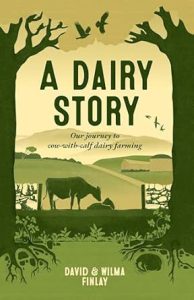
David and Wilma also wrote a book of the same title about their journey. The cover is pictured. Available from Amazon and good book shops