Pasta I Love Thee. Let Me Count The Ways
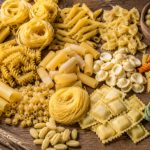 During my Royal Mile Tours for guests of the Edinburgh Festival Guides Association in August, I pose a question. How many individual performances were there in festivals in the city in the previous month of August? The answers are always wildly out: the only person who ever got close was a lady who thought she was being preposterous. But at least there is a definitive answer*.
Ask instead the question, how many types of pasta are there? Get counting. As I mentioned in last week's review, I defy you to come to a new part of Italy and not discover a new pasta name. Ah, name. There's the rub. As we all know, there is no such thing as Italian cookery. That means that the same pasta can assume a different identity simply by crossing regional borders.
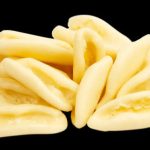
Cavatelli
The most extreme example of this which I've been able to discover is cavatelli. Not a pasta that I'm familiar with, but a fairly basic design, looking like an elongated sea shell, or, as one New York commentator described it, a hot dog bun. I've come on eighteen different names for it, including cicatelli, cavateddhi, orecchie di prete, and rascatelli.
Needless to say, there is a book on the subject, The Encyclopedia of Pasta, by Oretta Zanini De Vita. That lists 1300 names; however, as we've just seen, that doesn't assist in working out the exact number. The Italians love their diminutives and suffixes. Take spaghetti, spaghettini and spaghettoni. Normal, thinner, fatter. I have been served tortelli, tortellini and tortelloni at the same meal but I couldn't explain the differences off hand.
The theory is that you adapt your pasta shape according to the sauce you intend to serve. That might justify about six. It's clear that over the centuries Italian imaginations have been allowed to run riot. Obviously these days factory made ones are more common. In the UK we've become familiar with some of the more esoteric ones. Fusilli, looking like corkscrews; farfalle (butterflies).
But come to Italy and experience the full panoply. Radiators and bells; little stars and snails. Obvious enough from their shapes. But schiaffoni (slaps) or strozzapreti (priest stranglers)? I believe the latter were created in an area and at a time when the Church was at its most venal, well fed priests living in luxury while the parishioners were on the bread line.
Some have sad stories. In Genoa they have a simple flat pasta which is very thinly rolled and cut into small pieces. They are known as mandilli de seta (silk handkerchiefs), recalling the numerous times that wives would wave off their seafaring husbands, knowing that if they ever did see them again it might be two years hence. Occasionally they may have other meanings. Meet any Sardinian away from his homeland, mention fregola and you'll bring a smile to his face. That's the tiny couscous-like pasta which forms the base for so many glorious fish dishes. But in northern Italy it can mean a crush, as in teenage infatuation.
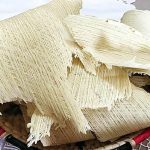
Su filindeu
Sardinia is also home to the world's rarest pasta, su filindeu, meaning threads of God. It's made by pulling and folding the pasta into 256 perfectly even strands. They are then stretched to dry across a circular wicker base known as a fundu in an intricate three-layer pattern. You may be familiar with the ultra thin capelli d'angelo (angel hair) pasta. Each strand of su filindeu is half the width of that. Commercial pasta makers have tried and failed to replicate this. Jamie Oliver went to take lessons from Paola Abraini, one of the last surviving makers. He had been making pasta for twenty years, but gave up after two hours.
So how many types of pasta are there? Hedging its bets, the Italian government's tourism website says over 300. I say, get travelling the country and start counting.
*Now obviously I know the answer to this particular question, but I'm not telling you. To find out you'll just have to come on one of my tours.
Tom when we were at a cottage over the summer my Italian daughter in law and a 17 year old Donaldson grandson made homemade pasta. It was beyond delicious. My favourite meal of the summer and I love steak in summer.
Great memory. I’ve made my own pasta a few times – some better than others, with a few disasters along the way. Hope you’re enjoying the posts from Ravenna.
Bumped into bucatini recently, delighted to have met this classy Italian. Spaghetti with a hole in the middle to pinch a mint makers phrase. So much more texture and flavour than the humble spag. Always the pasta to the sauce.
Good to hear from you, Colin. I’m well aware that it’s supposed to be pasta to the sauce; however, as I am so crap at judging quantities I usually end up with far too much sauce. Made my famous home sauce yesterday. Tastes so much better on a warm balcony with some great Chianti at half the price we’d pay at home.
Ah La Dolce, Tom. Weirdly am lunching in Cowdengelly Lidl’s car park, nae balcony !
Serves you right!
From my little corner the answer to the question is two: with added egg and without. The rest comes down to adding various colouring agents and cutting the dough into different shapes, and here the possibilities are literally endless!