Chilli For Beginners
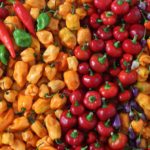 Once again, remember the target audience. Not the expert. While I'm reasonably comfortable with chilli these days, it's not so long ago since I served up dishes which verged on the inedible. When the legendary Delia ventured into recipe publishing, she infamously wrote one containing a tablespoonful of chilli powder instead of a teaspoonful. As an aside, there is a dish I make from her excellent Summer Cooking book which I've had to tone down severely. Thirty years on, even she was capable of heat related errors.
On a scientific basis, what do we mean by heat in this context? It's all based on something called the Scoville scale, a system used to measure the heat of chilli peppers. Named for one Wilbur Scoville who invented it in 1912, it rates this in Scoville Heat Units (SHU). These, apparently, are based on how much a chilli extract must be diluted before its heat is no longer detectable. Mild examples like bell peppers score 0 SHU, while extremely hot chillies, such as the Carolina Reaper, can exceed 2,000,000.
Here in Britain, for years our only exposure to chilli would be in the form of hot sauce (Tabasco being almost the only one we knew), or in powdered form. But today, let's focus on fresh.
I'm speaking to beginners here so we're probably shopping at supermarkets for now. There is a whole wide world of wonder out there in Oriental, Asian and African stores, but one step at a time. Supermarket chillies are often very douce beasts, usually in the range 2000 - 8000 SHU. They will have a code on the packet to give you an idea of the heat, usually based on a scale of 1 - 6 in the form of a graphic. It can take courage (or stupidity) to take a large bite out of a chilli; however, if you cut a tiny sliver from near the stem, that will give you an idea of the heat. Have a glass of cold milk (not water) to hand, just in case you get a nasty surprise.
To deseed or not to deseed? James Martin regularly asks what's the point of using chilli if you take the seeds out. He's wrong for two reasons. Firstly, if you're using chilli purely for heat, you're going back to the Neanderthal days when us lads used to boast about how hot a vindaloo we could eat. Good use of chilli is, or should be, as much about flavour as any other component of your dish. Secondly, contrary to popular belief, the seeds aren't the hottest part of the fruit. It's in the membrane to which they are attached that the real heat centre lies.

For deseeding chillies (top part) and hulling strawberries (lower part)
I will often deseed, not least because my nearest and dearest likes less of a kick than I do. The picture shows a wonderful little gadget from Lakeland which does the job brilliantly. Having said that, before you brand me as a complete wimp, I will enthusiastically garnish my Thai food with chopped seed-on little red chillies.
But let's get brave and shop in real shops or markets, without poncy packaging and health warnings. The best advice is to ask the seller. Not only will they advise, they may chuck in a favourite recipe as well. A great source of advice is Dougie Bell of Lupe Pintos, a real expert on the ways of Mexico and the southern US of A. A real eye opener for me was the discovery of chipotle peppers. These are dried and smoked jalapeňo peppers. The tinned ones are even better, adding a tangy sauce with tomato and more chilli. This is a vivid example of using chilli for flavour as well as heat. Follow Dougie's recipe for chilli con carne and you won't go back.
I'm writing this in the Caribbean, home to the ferocious Scotch Bonnet. These usually rank between 100,000 and 350,000 on the Scoville scale. During an earlier visit I was very confused by eating fairly mild dishes such as rice and peas and discovering that Scotch Bonnet was involved. The secret? Simply pierce the fruit a couple of times, and remove before service. Again, the flavour, not the extreme heat. (The same principle applies when using garlic. Crush it or chop it finely and it will be as strong as it gets: use a whole clove (in one famous recipe 40 of them) and you'll be surprised how mild it can be.)
The flavour versus heat thing applies equally well to hot sauces. For years, the only one I was aware of was Tabasco from Louisiana. Wonderful stuff, bringing sweetness as well as zing to a Bloody Mary, to a Marie Rose sauce or a smashed avocado. There are now hundreds out there. Every food fare features new examples. My experience is that many focus on the heat at the expense of taste. Sample before use.
And a quick word about the dried stuff? A serious health warning here. These things can be vicious. One of my daughters gave me a jar of dried chilli flakes. They did their job well, while still behaving, but I finished the batch quite recently. For years I had in the cupboard a large jar of tiny whole dried chillies from Spain. These on the other hand were bandits. I was terrified to use them in case I forgot to take one out and some poor sap bit into it. So they're now all blitzed, suitable for use as chilli flakes in food or in chemical warfare. I'll conclude by repeating yet again the mantra from my late mama. You can always add, but you can't take away. Have fun experimenting.
This is very useful info. One of the best things to have to hand is a poster showing photographs of the peppers, listed in order of their Scoville heat units. I found a very good one on line. It’s complicated when purchasing from a supermarket because they never seem to label the peppers properly so you might think you know what to expect and then get caught out. I grew chilli peppers in my greenhouse and was astonished when I burned my fingers when simply picking them! Watch out!!
Blitzing the wee dried chillies was not a good idea. They are fine but you have to remember just to use one
Some people are never happy.