London Food: What is London Food?
 On our regular jaunts to the capital we enjoy a couple of principal activities. Food obviously is one of them. Purely, you understand, in the interests of keeping you informed, dear reader - and this trip has yielded three yet to be written articles. We also spend much time wearing out shoe leather following the many routes to be found in three terrific little books entitled London's Hidden Walks by Stephen Millar. He has now produced one on Edinburgh. I commend them all to you. You'll find nooks and crannies whose existence you never suspected, and learn much about the city's traditions.
And thence came the idea. Food and tradition. Think London food these days and you could be forgiven if your list included fried chicken, pad Thai, dim sum, jerk chicken and pho. But let's go food foraging a century or two ago and see what we can find.
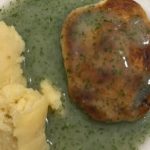
Pie Mash & Liquor
Read any history of London and it will stress the importance of the River Thames. For transport and shipping, certainly. But once upon a time before the curses of pollution and over fishing struck, it was an important source of food. Eels were ten a penny. (Actually, I suspect they were much cheaper.) Jellied to preserve them, they symbolise much of our stereotype of Cockney culture. Another one of these is the pie and mash shop. Originally you would get eel pies. These days, minced beef is used. The actual meal is pie, mash and liquor. The liquor is a thin parsley sauce. Traditionally it would have been made using the liquid in which the eels had been cooked. Once numbered in their hundreds, there are but a few pie and mash shops still to be found.
The river yielded more. Whitebait dinners were common in riverside taverns. Tiny fish, dusted in flour and cayenne, fried and served whole. Very tasty if well done. The only problem is that there is no such fish as a whitebait. We're simply talking about tiny immature fry of a variety of species. Another reason why fish died out in the river.

Mouth of a Lamprey
I knew you would get upset if I failed to mention the lamprey. King Henry I, it is said, died of eating a surfeit of them. Hands up if you know what it is. Superficially similar to an eel, it would have been reasonably abundant in the Thames in those far off days. Going back to Jurassic times, it is a jawless creature with a mouth like a Doctor Who monster. For some reason, at her Coronation banquet Queen Elizabeth II was served a lamprey pie. Another was produced for her Silver Jubilee in 1977. Come the Diamond Jubilee, alas, the lampreys had to be sourced from the Great Lakes of North America.
The importance of immigrants in the development of London's food culture (or indeed, anyone's food culture) cannot be overstated. The idea of frying fish in batter was introduced by Jewish immigrants from southern Spain and Portugal. The dish itself probably originated in north Africa. In 1838 Charles Dickens made reference in Oliver Twist to a fried fish warehouse. With your fish at that time you would probably have been served bread and butter or a baked potato. It would be another twenty years before London's (and probably Britain's) first fish and chip shop was established. But if you read last month's Tom Eats! column you knew that.
Another important Jewish introduction was the salt beef bagel. For this we have to thank the Ashkenazi Jews from central Europe. They brought their method of preserving beef - you cure it in salt and spices, then gently simmer it. As for the bagel, I have no idea why someone decided to boil dough before baking it, but that's how you make them.
Let's not forget those who have a sweet tooth. We do know that Eton Mess is traditionally served at the annual Eton v Harrow cricket match. (At the other school they call it Harrow Mess.) I discount the tale of the dropped pavlova as apocryphal. It is a combination of strawberries or sometimes banana, meringue and cream. The first mention in print is from 1893. Far too much of an arriviste for today's column.
Go back instead to the 18th century, to the Chelsea Bun House where they invented - you're ahead of me - the Chelsea bun. It's an enriched dough with sugar and dried fruit. It looks similar to a cinnamon roll which, I suspect, has surpassed it in popularity. And do I hear you call for muffins? Do you know the muffin man, who lives on Drury Lane? Muffin men were popular street sellers, to be found at dusk ringing bells to advertise their produce. But don't confuse that with today's ubiquitous American muffin, which is a fluffy cake, often containing fruit. The London variety was a small round, flat, leavened bread, which you would take home and toast at the fire. You'll find them at the base of a properly made eggs Benedict.
I'm conscious that I haven't given you anything to drink. Beer, probably. London was a great brewing centre. So called small beer (with as little as 0.5% alcohol by volume) was incredibly popular - and even given to children, because the water supply was notoriously unhealthy. But does it count as London food? I think not. Fuller's famous London Pride beer dates only from 1958, so that's no use. And London gin? Well, they had plenty of the stuff; however, the adjective London refers to the style of manufacture, not the place. Maybe that's for another article.
I would venture that in London today you will sample as wide a range of cuisines as you'll find anywhere else in the world. And if you avoid the swankier places you may be pleasantly surprised by the value for money. More than can be said for much of my own dear city of Edinburgh, but that's a preface to an imminent Tom Eats! column.
Working in South East England in the seventies I had business in the East End of London one day. I came across a pie and mash shop. Always adventurous, I planned to try the jellied eels. The tiny l eels in chopped up green looked disgusting – I couldn’t bring myself to try them. So I tried the pie and mash instead the pie was pretty disgusting! Not surprised the shops have died out.
I keep meaning to try this, but I suspect L would refuse. Your comments are not strengthening my resolve.
Excellent piece and an enjoyable read. We have Canadian cousins who visit on occasion. I’m forwarding this for their next trip, later this summer. Let us know how you get on with the jellied eels!
I think it’ll be a while (until Hell freezes over) before I can persuade L into one of these places, but it’s on my list.
🤮
I think this is my wife’s comment on jellied eels. Wait till she sees what’s coming soon in Tom Cooks!