What’s In A (Food) Name?
In last week's Saucy Mothers article we touched a bit on the naming of sauces. But if you look, not even that carefully, you'll discover numerous names in food nomenclature. People and places, pandering to divas, sucking up to aristocrats, and a few downright dodgy stories.
As with the origins of sauces, which we looked at last week, the creators of new dishes are often lost in the mists of time. If you are asked about it in a pub quiz, the answer Escoffier has a reasonable chance of being correct. Though fans of fellow French genius Marie-Antoine Carême may contest it. Both have been credited with
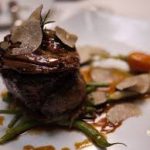
Tournedos Rossini
Tournedos Rossini, a heart stopping concoction of fillet of beef, foie gras, truffles and Madeira sauce. The Rossini in question was Gioachino, of Barber of Seville and William Tell fame. For once, the man himself may have had a hand in its creation, possibly by Casimir Moisson, a chef at Maison Dorée in Paris.
If true, that would be quite rare. We can definitely credit Escoffier with a couple, inspired by his devotion to Australian diva Nellie Melba. She couldn't eat ice cream, she moaned, because of its effect on her vocal cords. Too cold. Our Auguste thought that if he combined the stuff with fruit and sauce it might be OK. Have you ever eaten a peach Melba that wasn't cold? Then there was the day that she couldn't manage her toast because of a sore throat. So our hero split the bread in two to create ultra thin and crispy Melba toast. Wouldn't fancy that if my tonsils were giving me gyp.
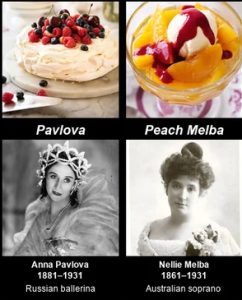 Another Australian star gave us Pavlova. The eponymous Anna was a ballet dancer, and the dish was a posthumous one, inspired by the alleged resemblance between a frothy meringue and a tutu. While she may have been an Ozzie, Australians and New Zealanders will fight like cat and dog to claim credit for it.
Where someone has been responsible for a new dish, it's not unreasonable to have a name attached. This can be either the recipient or chef. A fine example of the former is the hungover New York banker who came up with the idea for Eggs Benedict. But perhaps the most inspired invention of the last century must have been Caesar Salad, created out of necessity because stocks had run low. It was originally known as Aviator Salad, but Cesare (Caesar) Cardini went on to do very well out of his masterpiece.
Place names can feature too. Some connections are obvious. Sauce Bordelaise (from Bordeaux) is made with the local local red wine. The lesser known Sauce Périgueux, named for the Périgord region of France, involves demi-glace sauce enriched with the black truffles for which the area is famous. We wrote last week of chefs toadying up to their patrons. In one interesting example, both place and person are name checked. Béarnaise Sauce was a dedication to a Duke Henry. He came from Béarn (wherever that is) and would become Henri IV of France.
Sometimes it's less obvious. If you see Lyonnaise on a menu, the only certain thing is that the dish will contain a lot of onions. No one really knows why, other than the fact that it is the base of a lot of the hearty rustic cuisine for which Lyon is noted. There certainly is no sign of a hero to champion the onion. Contrast that to the potato, which had one Antoine-Augustin Parmentier to thank for its acceptance into French society and thence world wide. If you spy a dish featuring his name, something spud related awaits.
For those who believe that food and art are intertwined, Venice is the place. We have Giuseppe Cipriani of Harry's Bar fame to thank for a couple of modern day classics. By all means go to Venice; by all means sample these beauties; but UNDER NO CIRCUMSTANCES go to Harry's Bar. It resembles a 1950s formica lined, working men's social club. The atmosphere is diabolical and the prices, as you would expect, are eye watering. That, however, doesn't detract from two of his inventions, the Bellini, and Beef Carpaccio.
A Bellini is a cocktail of prosecco and white peach purée. If the bar is a reputable one, it will sell it only when the peaches are in season. Most places, however, will palm you off with juice from a carton. Anyway, our Giuseppe thought the pale pink colour of the drink reminded him of the colour of a saint's garment in a picture by Venetian artist Giovanni Bellini, hence the name.
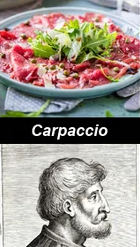 It's a similar tale regarding Beef Carpaccio. One of Cipriani's regular customers, one Countess Amalia Nani Mocenigo, had been advised to eat only raw meat. Having carved the beef as thinly as possible and served it with just a light dressing, our Giuseppe's thoughts returned to his favourite artists. If you look at works by fellow Venetian Vittore Carpaccio, you will see he favours deep red and white tones.
I could go on. Take Sauce Mornay. Attributed to the Duke of the same name, it's basically Béchamel with cheese, traditionally Gruyere and Parmesan. The only trouble with that theory is that Béchamel hadn't been invented in the Duke's time. Hey ho.
Most of the dishes we have considered today are things of loveliness, are they not?
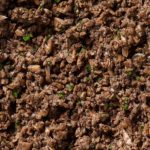
Mushroom Duxelles
But let's close with François Pierre de La Varenne, whom we met last week, chef to Louis Chalon du Blé, Marquis d'Uxelles. He too created something to bear his master's name. Take a load of mushrooms, finely chop them and cook them very slowly until the moisture disappears. There you have mushroom duxelles (d'Uxelles.) This is very fine thing when used, for example, in a Beef Wellington, but on its own it looks like ... well I leave it to your imagination (see right). Can you picture our François inviting the Marquis to the kitchen, producing a pan of deep brown sludge and saying, hey boss, I made this and thought of you? No, I can't either.