Cooking: The Book(s) That Influenced You
Getting something On The Side is ticklish. Note I used the capitals to stop the sniggering in the back rows. Childish. Really!
The point is the varying degrees of difficulty presented by each of the columns in the blog. Food is infinite. If I felt the urge and, more importantly, if I thought your boredom thresholds could bear it, a Tom Cooks! column could be produced daily. The estimable Lindsey Bareham of Roast Chicken and Other Stories fame used to do just that for The Times newspaper.
 And if there are no Tom Eats! articles in the can, it's never a hardship to have to find somewhere new for a bite. Having said that, my once steady group of guest reviewers seems to have been afflicted by writers' block. Come along, Messrs D, S & M: you too, Ms H and Ms M. Where are you? Let's be 'avin' you. (On reflection, I remove Ms M from that list, as she has contributed this year. But the rest of you used to make my life much easier.)
But On The Side. Tricky. I don't really know any chefs or food producers. And when they promise material but don't deliver, one can hardly serve a subpoena. So I hope today will encourage you to send in details of the cookery book or books which inspired you in your early culinary days. I'm not looking for a long and polished column - just a couple of paragraphs will do. Or get AI to write something. I may notice, but I won't spill the beans. (Makes too much mess on the kitchen floor.)
The idea for today's scribblings comes from a Facebook page which I follow. It's entitled The Chef's Circle and I commend it to all of you, not least because of the thought provoking discussions which it opens up. A recent one was 5 Amazing Chef Books You Need On Your Shelf. Now, what does that mean? I think even the author was a little confused. He listed Anthony Bourdain's Kitchen Confidential and Gordon Ramsay's Humble Pie, both autobiographical. There was the one of a kind work of genius that is Samir Nosrat's Salt, Fat, Acid Heat. Then there were two classic cookery books, Thomas Keller's The French Laundry Cookbook and Fergus Henderson's treatise on Nose to Tail Eating.
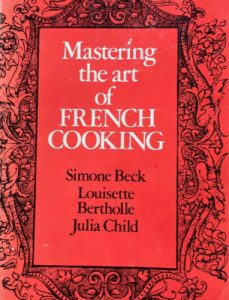
I'm interested in the latter category. I'm never sure whether I should write cook books or cookery books, but does it matter? I'm looking for your favourites. The ones you turn to now, or the ones that got you started. I confess, I rarely use books much these days, but I'm going to extol the praises of one (actually two) of the greatest. Ladies and gentlemen, I give you Mastering the Art of French Cooking Volumes I and II. The original was the work of Simone Beck, Louisette Bertholle & Julia Child: Mme Bertholle dropped out after the first book.
Volume I originally appeared in 1961, two years later in the UK. I can't remember when I first got mine, but the paperback version disintegrated a long time ago. It always opened at Boeuf Bourgignon. And the recipes, 7, 8 or 9 stages. Never seen the like before, but I followed them all. I even tried to measure an eighth of a teaspoon. And the results, I have to say, were always spectacularly good. In fact, I will proudly assert that my beef bourgignon is the very best in the world. I challenged a Frenchman once, but he backed down. But, of course, when I say my I mean theirs. The three ladies founded a cooking school in Paris in the 1950s, L'Ecole des Trois Gourmandes, and decided to distil their knowledge into book form. The first effort was hardly a success. Six years' work yielded eight hundred (yes, 800) pages on sauces and poultry!
A helpful publisher pointed them in the right direction. Volume I runs to 670 pages in hardback. As well as numerous recipes, it covers kitchen equipment, ingredients and knife skills. I remember my early dalliance with Indian food. Eventually I found something within my capabilities, or so I thought. But that recipe called for a chicken to be jointed. I had no idea how to do this but I knew that MTAoFC would tell me. (I recall it took me about an hour and a half. I'm quicker now.)
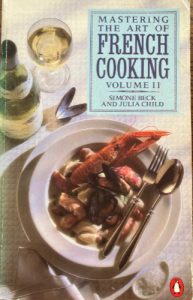 Some important principles run through their work. With cooking, they declare, there is but one goal. How does it taste? The French are seldom interested in unusual combinations or surprise presentation. Amen to that. The recipes are incredibly detailed by modern standards. A recipe for lobster bisque in volume II runs to five pages with eight separate techniques. Precision in small details, they write, can make the difference between passable cooking and fine food.
Foolishly, I thought I had outgrown this book. Even in France, cooking has moved on hugely since the 1960s. We use less butter (unless you're James Martin) and, as you will know, Le Chateau Johnston is a cream free zone. Chefs don't use flour to thicken things any more. Does it still hold any relevance today?
I reread the intro to the first book. The ladies are writing my cooking mantra for me. "Too much trouble" or "who will know the difference" are the death knells for good food. And then I looked at the contents pages to see what I was missing. Book I has 100 pages on veg: book II covers only seven topics but it has 128 pages on bread alone. How could I have been so stupid to have left it behind?
I already owe these ladies a huge debt of gratitude for what they have taught me. I now see that there is so much more to be absorbed. Many pleasures to come.
What book or books have influenced you as a cook? Which are the best thumbed volumes on your shelves? Please share them with us.
We still have the Hamlyn All Colour Cook Book. It was published in 1970 and our edition was the 15th impression in 1977. As a relatively newly married couple back then we referred to it as lot. I must confess to not having opened it in years. However we still have our copy and one of the main contributors is Mary Berry. Looking through it today so many of the recipes are still in demand today. There are some great dishes such as Mackerel en papillotes or Orange Tarragon chicken and Hungarian Lamb. There is a large baking section for cakes and also many sweets.
It’s like having a reunion with an old friend
Splendid! Thanks for that, Paul.
I suppose I should begin as a child, because all good food stories begin with one: a small, slightly bored creature left to their own devices on a long Sunday in Scotland. Mine involves a six-year-old me. Not a storybook, you understand. Not pirates or detectives or anything so narratively generous. The BeRo book. The sort of thing that suggests utility rather than wonder. In a household where the clock ticked louder on Sundays and the hours stretched like overworked dough, it became a gateway.
Because there is a particular kind of boredom that does not deaden but provokes. The kind that nudges you towards flour. Towards butter. Towards the quiet, radical act of making something edible from almost nothing. Homework dispatched with indecent haste, I found myself in the kitchen, producing scones and cakes for the family. Not out of altruism, you understand. Out of necessity. There are only so many times one can reorganise a pencil case before one must confront the deeper existential question: what if I baked something?
Years pass, and the BeRo book gives way to something more serious. The Glasgow Cookery Book arrives like a stern but benevolent headmistress. It has recipes for almost everything. Full stop. No whimsy, no indulgent narrative, just instruction. It does not care for your feelings; it cares that you understand the difference between folding and stirring. It is, in its own way, a kind of culinary Calvinism. And it works.
Then comes my first flat. that echoing temple of independence where the fridge contains little more than hope and a questionable bottle of milk. Here, another voice enters the scene. “One Is Fun,” says Delia, with the calm authority of someone who knows exactly how long an egg should take. And she is right. Cooking for one becomes less a chore and more a quiet pleasure. A private performance with no critics, save yourself, and even you can be forgiving after a glass of something inexpensive.
Adulthood, or something approximating it, brings with it shelves of cookbooks. They accumulate like well-meaning acquaintances. Some are dipped into once and abandoned. Others are admired for their photography, those airbrushed fantasies of domestic perfection. But the true measure of a cookbook is not how it looks on the shelf. It is how it behaves under pressure. Does it lie flat? Does it splatter? Does it bear the scars of use?
Which brings us, inevitably, to Prue Leith. My only truly grown-up cookbook, or so it felt at the time. And despite the abundance of volumes now residing in the house, it is Prue’s, along with those earlier companions, that show the real signs of life. Pages that cling together slightly, as though reluctant to part. Margins that bear the faint imprint of buttered fingers. The unmistakable gloss of something once liquid, now historical.
These are not pristine objects. They are not meant to be. They are working documents, records of trial and error, of hunger and its satisfaction. The gloop, you see, is the point. L in Tom Eats! can cook and feels that she deserves to recommend more than one volume.
Crikey! I can attest to the fact that L can cook extremely well. But I must protest about this comment. Prose of this quality is just showing me up as the rank amateur I am. I am used to complaining to Jay Rayner for putting the rest of us in the shade, but I didn’t expect such treatment from the other side of the dining table.
PS. Who can tell me, without Google, what BeRo stands for?
My oldest cookbook (1980s) and still referred to today is The Sunday Times Complete Cookery Book. Main sections – Fresh Food Guide – Complete Cooking Techniques and Entertaining. Large format with beautiful illustrations photographs, drawings and well known paintings all in colour. Recipes for all standards. Best one I did was a boned turkey with 3 different stuffings and Madeira gravy. My copy is a bit shabby but I sourced a mint edition for my daughter a few years ago on World of Books.