Alioli & Friends
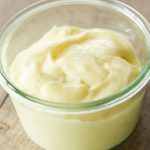 Today we're looking at a family tree. Until the recent Menorcan trip, I would have said that we were considering siblings in the shape of mayonnaise and Spanish alioli, otherwise aioli. I knew that rouille was but a cousin. For a long time I was unaware precisely how it was made, just that its garlic loveliness on crispy croutons raises a good fish soup to another level.
I won't insult you by asking you to name the odd one out. Mayo, obviously, as the other two have garlic. So let's begin there. As it's one of Escoffier's five mother sauces, I was tempted simply to give you his recipe; however, as a professional chef, he gives recipes in commercial quantities. Let's see what else is out there.
Mayonnaise
Why don't people make it? Fear is one reason. In my case, while I can do it, I've never quite mastered the flavourings to get really good stuff. But you will do better if you just follow some simple rules.
- Make sure all the ingredients are at room temperature
- Egg yolks - they must be beaten a little before you start to add the oil
- Adding the oil - at the beginning this must be added a tiny bit at a time, otherwise the sauce will curdle
I rather like James Martin's recipe. I saw him making this recently on his Spanish Adventure. All done by hand, he made it look very easy. His own recipe uses a neutral oil. He pointed out that in Spain he risked lynching if he didn't use olive oil. This was what Pat Davenport, my former mother in law did, using the very best oil. It was green and magnificent, but too heavy for some.
*For this recipe I use neutral oil such as vegetable or rapeseed. If you like (and I do) add a tablespoon or two of your very best olive oil. You may not need it all. The classic proportion is quarter of a pint (142ml) per egg yolk
Use white pepper for this. You don't want it to appear that a swarm of small flies has landed in the kitchen.
Ingredients
2 egg yolks; 1tsp Dijon mustard; 1tsp vinegar (white wine or cider); about 300ml oil (groundnut, vegetable, or sunflower oil, with or without a couple of tbsp of olive oil) - see above*; squeeze of fresh lemon juice; salt and freshly ground white pepper.
************************************************
Place the egg yolks, mustard, and white wine vinegar into a medium bowl and whisk until smooth. Whisking constantly, slowly drizzle the oil into the egg mixture drop by drop at first. Whisk continuously until it starts to thicken. This is good for arm muscles/bingo wings. Once the sauce is thick and glossy, whisk in the lemon juice, a pinch of salt, and white pepper to taste,
Keep in the fridge and use within a couple of days. This is a health hazard if not looked after carefully.
Alioli/Aioli
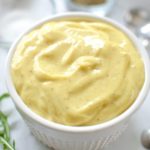 For a long time I thought this was simply mayo with added garlic. If you want to do a cheat's version, just grate a little garlic into some good ready made stuff. Do NOT follow The Leith's Cookery Bible suggestion of adding six cloves. If you do, chuck it straight in the bin.
But Josep, the Menorcan tour guide, assured me that in traditional recipes, no eggs are used. The Larousse Gastronomique considers both possibilities. Here is their egg free version. I haven't tried it.
Ingredients
1 whole head (not clove) of garlic, unpeeled; 150ml olive oil; 150ml neutral veg oil; s & p.
*************************************************
Cook the garlic in a hot oven for about 30 minutes. When cool enough to handle, peel the cloves and mash to a pureé. Season with s & p, then gradually work in the oil, as for mayonnaise, until you have a thick sauce.
Rouille
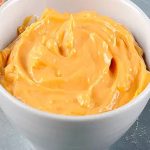 In some ways rouille is a combination of the previous two. If your knowledge of French vocabulary is esoteric, you will know that the word means rust. No prizes, then, for guessing the colour, which it gets from saffron and chilli. It's quite a thick consistency. Some recipes use breadcrumbs, some potatoes. On the basis that it will normally accompany a fish soup, my favourite is to use potatoes which have been cooked in the soup; however, bread seems to be more common.
As ever with anything French, the Larousse gets fancy. They stipulate scorpion fish livers, Curiously, my fishmonger had run out. Interestingly, they use no egg at all. Rick Stein has a nice simple recipe, but he uses harissa (OK) but no saffron (not OK). When using saffron, mix the threads in a little water for a few minutes before using.
I rather liked this one which I've adapted from an online recipe. In the mayo recipe I gave you the classic do-it-by-hand version. This one is done in a machine. You can apply this technique for any type of mayonnaise.
Again, I haven't tried this recipe. *I am raising my eyebrows at 2 yolks to 150ml of oil - I think you may need more.
Ingredients
150ml olive oil (see above*); 2 egg yolks; 1 tbsp Dijon mustard; 2 garlic cloves; 1 slice of white bread; 6 strands of saffron; 1 tsp regular paprika; 1 tsp cayenne pepper; 60ml liquid - fish soup if you're making it, which failing fish stock, which failing water; salt.
************************************************
This is a quick recipe for mayo I use from India Knight’s substack. I’m not a foodie but I find this good, quick and reliable:
Mayonnaise
1 large egg
1 tablespoon (15ml) lemon juice (from 1/2 a lemon)
1 teaspoon Dijon mustard
1 medium clove garlic, minced
1 cup (240ml) vegetable or canola oil
Sea salt
Place egg, lemon juice, and mustard in the bottom of cup or jar that just fits the head of your immersion blender. The egg/lemon juice mixture must reach the blades for this to work (see note). If the mixture does not reach the blades, double the recipe before attempting.
Add garlic, if using. Pour oil on top and allow to settle for 15 seconds. Place head of immersion blender at bottom of cup and turn it on high speed. Do not pulse or move the head. As mayonnaise forms, slowly tilt and lift the head of the immersion blender until all oil is emulsified. Season mayonnaise to taste with salt. Refrigerate in an airtight container for up to 2 weeks.
Thanks, Liz. 240ml of oil for one egg yolk. Interesting. Must give it a go. I have a mini mixer and used to wonder whey there was a little hol in the lid. Same idea, I guess.
Note that the recipe states a whole egg, not just a yolk. It works. Just don’t be tempted to start lifting the blender too soon, wait until clouds of the emulsion begin raising through the top layer of oil (it is a magical moment!) and only then start moving the blender up, incorporating more and more oil into the concoction. A pinch of sugar is advisable.
Thanks, Slav. My recipes use yolks only, but I see that my pal Liz’s recipe calls for a whole egg. But sugar? In mayo? Hmmm.
A pinch. A two-finger pinch. Not to make the sauce sweet, but to tame the acidity. Anyhow, I suppose it’s a matter of personal palette. Not at all necessary. As, in fact, any of the ingredients bar the egg and the oil. Subjectively, I’d rather hmmm at garlic in my mayo and at the absence of some ground white pepper. But there we are.
I maintain my hmmm. And it would be exceedingly difficult to make aioli/alioli without garlic!
The comment was not on any recipe within your the article, Tom, but on Liz’s (or rathe Ms Knight’s) offering above which is titled Mayonnaise.
Within the recipe itself it reads, “garlic, if using”. I’m a great believer that recipes are indicative only, not prescriptive. Don’t fancy something? Leave it out. Don’t have a particular ingredient? Work out what might be a decent substitute.