There Must Be Fifty Ways To Fry Your Onion
Well, probably not, but I was listening to Paul Simon quite recently, which may or may not have inspired this.
The onion must be the most frequently used ingredient in cooking. (I had a friend of a friend who had an allergy. Lord knows how she coped.) They form the basis of countless soups, sauces, stews and casseroles, feature prominently in many national cuisines and are used in an extraordinary variety of ways. Yet how often do you stop to consider the different ways in which an onion can be fried?
There is, after all, a considerable difference between a gently softened onion, a golden brown one, a batch which are deeply caramelised and a crisp, deep fried one. Each has its own characteristics and culinary uses.
Now as you read on, you may say, Oy Johnston! that’s no more than ten! Well, having made the early concession, I’ll reply by asking how you cut yours up. For a risotto you want the pieces to be so small that they melt away altogether, utterly invisible in the finished product. Chunks for stir fry or rings for deep frying are quite different, and when browning you have many choices. Half moons, say, or strips? Or in the brown braising for a classic beef bourgignon where you use whole baby ones.
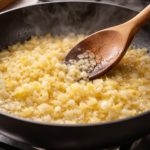 Sweating is perhaps the most basic technique. Finely chopped or sliced onions are cooked gently in a little butter or oil, usually over a low heat. The intention is to soften them without allowing them to brown. Their moisture is gradually released, their pungency diminishes and their flavour becomes milder and sweeter. Sweating is commonly used as the starting point for soups, risottos, sauces and many casseroles.
Shallow frying involves cooking onions in a little more fat, usually at a moderate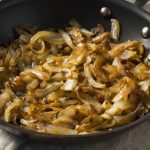 temperature, until they begin to take on colour. The resulting golden-brown onions have a more pronounced flavour than those which have simply been sweated. They are widely used in meat dishes, omelettes, vegetable preparations and curries. When cooking a few months ago with my redoubtable Indian friend Tahira Nasim I was concerned that the veg were going a bit too dark. Absolutely not, she said, you want them as brown as me.
Caramelising onions is a rather different process. The onions are cooked slowly over a low to moderate heat, often for 30–60 minutes, until they become very soft and deeply brown. Their natural sugars become concentrated as moisture evaporates, while caramelisation and the Maillard reaction contribute to their complex flavour. The result is a rich, sweet and savoury preparation, frequently used in French onion soup, onion tarts and as an accompaniment to meat. Despite occasional claims to the contrary, adding sugar is not necessary. Don’t confuse this with the abominations produced on cheap hamburger stands where the onions are simply burnt at the edges and serve to take away the taste of the horrible dogmeat which they dish up.
Stir frying provides almost the opposite result. Onions are cooked quickly over a high heat, usually in a wok or large frying pan. The objective is to brown their surfaces while retaining some crispness. The technique is particularly common in Chinese and other Asian cuisines. It is important not to overcrowd the pan, as excess moisture can cause the onions to steam rather than fry.
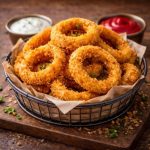 Deep frying produces an entirely different result. Onions, cut into rings or thin slices, are immersed in hot oil until golden and crisp. Onion rings are perhaps the best-known example, usually coated in flour or batter before frying.
We really could go on. Confit onions, slowly cooked in fat; onion bhajis; bawang goreng, the crispy fried shallots widely used in Southeast Asian cooking as a garnish.
But for a final set of variables, take care in your choice of cooking material. Butter provides a distinctive flavour but can burn at high temperatures because of its milk solids. That’s why a combination of butter and oil often works best, oil for heat, butter for flavour. But which oil? Vegetable oils are generally more suitable for deep-frying. My go to is always olive oil, but it may burn at high heat. Ghee on the other hand, (clarified butter) can withstand high temperatures because the milk solids have been removed.
So, you want to know about frying onions? You don’t need to be coy, Roy, just listen to me.