Slav Shumov’s Beef Stroganov
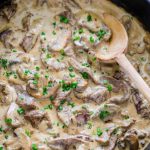 This recipe (and its author) require a little introduction. Slav and I have never met. He blew into the blog a few months ago and took to reading with some care my back catalogue. New readers are very welcome. Constructive criticism is also welcome, though perhaps in smaller doses than I got over a month or two.
All I know is that he is of Russian extraction, has lived in London for most of his life, and a chunk of it in Angus. He is clearly a fine man, as he's now a customer of Castle Game and recently made a splendid Venison Wellington for 10 from a saddle of roe. He sent me this recipe as a thank you for the introduction. I asked if he would like to contribute a photo. Answer there has come none. He must remain an International Man of Mystery.
I don't have quantities for you - use your judgement. You may, like me, have been surprised by the use of double cream as opposed to sour. Here is Slav's reply-
As for Stroganov, with double cream being a luxury food item in the USSR (unless you were a peasant and had your own cow, in which case, perversely, you wouldn't have been able to afford eating beef) and lemons being somewhat exotic and expensive in the European part of the country, the substitution by sour cream is natural. It was out of necessity. Also sour cream curdled on me a couple of times when left to simmer for a second too long.
I stick to the original French variant with acid being added off-heat and just before plating.
Just before I pass over to the man himself, a couple of comments from me. Slav, if you have a problem slicing meat thinly, my friend, you need a better knife; however, I love the idea of having a beautifully cooked medium rare steak, sliced, instead of little grey strips. Interesting that he uses sirloin, not fillet. I think I approve. Usually more flavour.
Slav Shumov's Beef Stroganov
Ingredients (serves 2)
Decent sized, thumb thick sirloin steak, fat removed; sliced onions; sliced mushrooms; flour (aaargh! - Ed); brandy; beef stock; double cream; mustard; paprika; lemon juice; butter; s & p; chopped parsley to serve optional).
************************************************
Here it is. The main advantage of this method is that one doesn't need to thinly slice raw meat (never works well unless the meat is part-frozen) and then fry the strips in batches (dull thankless task prone to killing the beef). Instead one can do the whole exercise with one hand, holding a G & T in the other, and an accidental fleck of fag-ash is yet to spoil the concoction.
A decent thumb-thick beef sirloin steak, fat off, season and fry in butter to medium-rare, set aside; in the same pan fry a sliced onion until just starting to brown, set aside; in the same pan fry sliced mushrooms until soft, set aside; deglaze the pan with brandy, add more butter, return onions and mushrooms, add flour, mix well, pour some stock; bring to a simmer, whisk in mustard and paprika followed by double cream and the juices from the resting steak; reduce or dilute as necessary. Check the seasoning. Slice the steak as thin as you like, add to the pan and turn the heat off; add lemon juice, mix and rest for a few minutes for the meat to warm through; chopped parsley to serve.
Editor's Historical Notes
As the recipe is fairly short, I thought you might care for a little history. The dish was almost certainly created in the kitchen of a wealthy Russian family named Stroganov. (Stroganoff is the French spelling of the name.) The only trouble is that no one knows precisely which branch of the family. Was it the one which spent time in Siberia where the chef discovered the meat half frozen and therefore had to cut it into strips? Possibly an ancestor of Slav? Or possibly yet another apocryphal food tale.
Anyway, the original recipe had but four ingredients. Beef, a sauce made with a roux, mustard, and smetana. The latter is the Russian word for sour cream, as well as a famous Czech composer. Onions and mushrooms came later. The first recipe appeared in 1871 in A Gift to Young Housewives, the influential Russian cookbook by Elena Molokhovets.
After the 1917 Revolution the dish was spread far and wide by Russian émigrés. It was probably the French who jazzed it up with onions and mushrooms, and probably the Americans who ruined it with tomato. Bizarrely, it became very popular in hotels in China. As with any dish which booms in popularity it became a bit of a cliché and one rarely sees it these days. Slav's recipe is a very fine version.
Спасибо!