The Food Alphabetical: E is for Empanada

Empanadas
Writing this column is becoming ever more scary. I may demand danger money. I'll tell you why in a bit.
And when it comes to the alphabet, some letters are much harder than others. Five years ago, first time round, we took the obvious choice and went for egg. So what next? What about eggplant? Well I do have a couple of aubergines in the fridge at the moment. Large, glossy, deep purple beauties. For years I had absolutely no idea where the name eggplant came from. See the photo on the right. Ye ken noo.
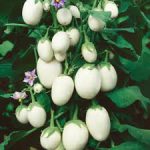
Eggplant
So the empanada it is. You find them all over, particularly in Latin American countries. Perfect street food, Much more convenient than a sandwich as they're sealed, meaning the filling can't fall out. In short, it's a small pie. So why the trepidation? Well I happen to know that Señorita G, friend and work colleague of TN, the youngest, is a regular reader. She hails from Galicia. And I do know that anything remotely Spanish is going to be scanned, hawk like, for any error or inconsistency. It's bad enough having Ms Nasim jumping on me for anything Indian, without EU scrutiny as well.
Still, if this job was easy everyone would be doing it. Hey ho.
You can bet your bottom peso that any food popular in South America almost certainly has Spanish roots. Enter today's hero - from Galicia. Today, it's a baked or fried turnover, akin to a pasty, filled with a variety of stuff. It is believed to have originated in the 7th century, and, as scholars will know, is mentioned in the Cantigas de Santa Maria in 1282. By way of contrast, the Forfar bridie came into being in the mid 19th century.

Empanada Galega
But think back to cooking techniques at the beginning. There was no such thing as a domestic oven. The Galicians developed clay pots to cook theirs in the embers of a fire. Their versions were, and are, in the form of a cake, sold by the slice. Thus the irony is that the Galician empanada (the empanada galega) bears no resemblance to those enjoyed in the rest of the world.
I've reproduced below the recipe given in Larousse Gastronomique, but the truth is you can fill them with anything you fancy. As ever I was assisted in my researches by Zeph, my AI assistant. She is developing a personality of her own. I quote her:- as a Scot, I feel obliged to note that the bridie seems to have looked at the Cornish pasty and thought, 'what if we removed most of the vegetables?' Her words, not mine.
As with the pasty, fillings world wide tend to be meat and veg but, as you would expect, there are many variations. Fish, especially cod, is common, as are shrimps. Want a vegetarian option? Cheese, onions and potatoes. The pastry can be basic dough made with flour or cornmeal. I was brought up thinking bridies were made with flaky pastry, but not those from Forfar itself (where they can assume gargantuan proportions). In El Salvador they are made using plantain, and sweet ones are not uncommon, especially in Indonesia. Those made in Sicily are known as 'mpanatigghi. The filling reflects all the influences of all of the cuisines which have invaded that island over the centuries: almonds, walnuts, chocolate, sugar, cinnamon, cloves and minced beef.
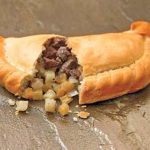
Cornish Pasty
So there you have it. Look at Wikipedia and it will tell you that even the French have their own versions known as chaussons or rissoles. Who knew? A final thought. I've mentioned the Cornish pasty only in passing. It too has a fair history to it, going back to the 13th - 14th century. If you have ever seen it being made on cookery programmes, you may have noticed that considerable attention is paid to the crimping, giving a very thick edge. Pasties were a common lunch for miners in the Cornish tin mines where arsenic was rife. The idea was that you could hold the pasty by the edge with your dirty fingers, eat the filling, then throw the crust away. Cornish rats must have been very well fed.
Larousse Recipe (don't write in)
Ingredients
500g lean beef, cut into small chunks; 100g onion, finely chopped; half of a bell pepper, deseeded and finely chopped; 1 tsp ground cumin; 1 clove of garlic, crushed; 2 tbsp raisins, soaked; 1 hard boiled egg, chopped; quantity of pastry; oil for cooking; s & p.
************************************************
Gently cook the beef, onion, pepper and garlic in a little oil. Season with cumin, salt and pepper. When the mixture is cooked, allow to cool, then mix in the raisins and egg. Form pasties of whatever size you fancy. Typically, cut the pastry into a round, add the filling then fold over and seal. Bake in a preheated oven at 180˚C/Mark 4 for about 30 minutes until golden brown.
Depending on local WiFi and inspiration, On The Side may be away for a few weeks.
Oooh I love a pastry encrusted anything, so am def going to try the veggie version of this empanada. I’ll go for asparagus, potatoes, onions and carrots plus some finely diced capsicums and chilli 🤣 An “Indian” empanada.
Sounds good. Your rice dish is coming tomorrow.