Knives from Nippon
 Forget sweetie shops. This overgrown kid can easily pass them by. But a shop selling knives and kitchen equipment? That's another matter. In Edinburgh, Nisbets in the West Port has often sucked me in with some strange, magnetic-like force. Purchases started small: tiny inconsequential pieces of kitchen ware. Then, as with any addict, there was the need for more, culminating in the ice cream maker with built in refrigeration unit. It lives in the upstairs guest kitchen. Come and stay with us. In the morning there is the wherewithal for you to make yourself a tea, a coffee or a wee cone.
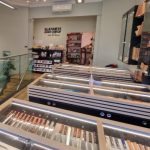
So it was inevitable that as I was winding my way down Baker Street, my progress was interrupted by the principal shop of the Japanese Knife Company. Goodness me! What a display. Founded in 1998 by Jayesh Patel, the company now trades in London, Paris and Stockholm, with five branches in London alone.
 Japanese knives are venerated. The myth and legend of the Samurai may have something to do with it, but it has to be said that so many of them are things of beauty. They are renowned for being able to take on a super sharp edge, the reason being that the steel is harder than European knives. Take one in your hand (and the lovely people in Baker Street are happy to demonstrate their wares) and you will be struck by how light it is. Watch a sushi chef in action or admire intricate displays of carved vegetables and marvel at the skill. But the weight, perhaps, is the rub. I consulted knife expert James Lothian, butcher extraordinaire at Castle Game.
He explained to me that Japanese blades can be more brittle. Use them for heavier duty work and you can easily chip them. European knives, on the other hand, are more robust and generally heavier. He went on to explain the optimum angle for sharpening both, which, I confess, went over my head. But be aware that in addition to purveying all manner of wondrous food, Castle Game now offer a knife sharpening service. If you have aspirations to be a serious cook, make sure your blades have a keen edge. It's so fundamental that I no longer allow participants in Chef Watch to list sharp knives as their favourite kitchen tool.
In my own small batterie de cuisine, I have about eight or nine, most of which have been gifted. I have a tiny paring knife which I may use should I ever learn how to turn veg. I also have a boning knife which is useful for lamb shoulder and for poking holes in my hand. Of the others, only three are used regularly, standard knives with different sizes of blade. If in doubt, use the bigger ones.
All of my day to day ones are European, German to be more specific. My one Japanese specimen is an all-in-one-piece Global knife, far removed from the beautifully tooled and handled examples to be found in Baker Street. It tends to be used for more esoteric stuff such as segmenting citrus fruit. There is no doubt that there is a certain status symbol element to Japanese knives, like owning a Mont Blanc fountain pen or an unusual watch. Price may come into that too. Buying any very cheap knife is usually a false economy, and good German ones are not cheap; however, go Japanese and the sky can be the limit.
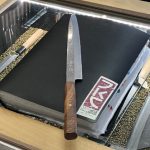 I came away from the shop with a copy of their gift catalogue. It has much good, affordable stuff, and an interesting range of other kitchen ware. Their website is well worth checking out. Having made it clear that I was not in to buy, I did ask to see their top of the range. It's pictured left. Yours for a mere five thousand pounds.
Japanese Knife Company
The strangest thing. This very day of publication, an article about Jayesh Patel appeared in Restaurant Online
under the heading The Man Who Changed How We Chop