Piccalilli from Piccadilly
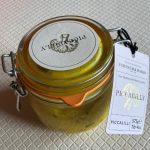 The title really isn't accurate, but who could resist such delightful alliteration? In spite of my sourcing our eponymous condiment on the self same street, the words have entirely different roots. In the UK, we've been preserving fruit and veg forever, but the idea of a specially made ingredient to tart up food came later. Even mustard, which was introduced by monks in the 12th century, didn't really catch on until the 18th century.
As you might expect, the catalyst was the trade in, and latterly colonisation of, India. Chutneys became very popular, and were (and still are) also an excellent means of using a glut of fruit and veg. Piccalilli is a made up name from the time when pickling spices were added to veg. The earliest reference is to an English cookbook from 1758 which gives a recipe for Paco-Lilla or Indian pickle.

Man Wearing a Piccadill
And Piccadilly? A type of collar which you'll have seen in numerous paintings and episodes of Blackadder was known as a piccadill. It's a stiff, elaborate lace collar. In the 17th century a tailor named Robert Baker made his fortune selling them. He built a great house to the west of the city and named it Piccadilly Hall. As the area around it was developed it became known as ... oh yes, you're one step ahead of me.
I have made a version of piccalilli before but I'm blowed if I can find the recipe I used. It's not too hard, but deciding on the ingredients is. Broadly there are two types, regular and hot. The Fortnum's version which I like very much is tangy with mustard but not hot. Jamie Oliver's recipe on the other hand uses six chillies. Not for me.
Where piccalilli differs from most chutneys is that the veg retain a bit of crunch. Cauliflower, cut into tiny florets, is essential. So too are onions, ideally the tiny silverskin ones used for pickling. If you can't find these, or can't be bothered peeling them, use shallots cut into the right size. I hadn't given it much thought, but there are always green bits. Every recipe bar none specifies green beans. I'm using fine French beans. For extra green, as it were, courgettes are commonly called for, though some recipes use cucumber and/or marrow. Reading the list of ingredients on the Fortnum's jar, I see that they use carrots too. Turmeric is essential for the distinctive yellow colour. Don't spill on your clothes or table cloth.
Here goes. This is an amalgam of various recipes I've found. It will yield about 2 - 3 large jars.
Sterilise your jars and lids in a hot oven. I'm not guaranteeing quantities, so prepare more jars than you may need. At Christmas small jars of home made pickles and chutneys make attractive, low cost gifts. For piccalilli, try to cut the veg into pieces of approximately the same size.
Ingredients
1 small cauliflower (450 - 500g) cut into very small florets; 200g of either tiny pearl onions left whole, slightly larger ones halved, or shallots cut into small pieces; 200g courgettes cut into small dice; 100g fine green beans, topped and tailed and cut into small pieces; 600ml vinegar, (ideally 400ml white wine vinegar and 200ml malt vinegar); 2tbsp English mustard powder; small pinch dried chilli flakes; 1 level tbsp turmeric; 3tbsp cornflour or plain flour; 200g caster sugar; sea salt (at least 2tbsp).
************************************************
Put the veg in a bowl which will be large enough to hold the liquid as well and sprinkle liberally with salt. Leave covered for at least 4 hours (overnight is good). Rinse well, pat dry, return to the bowl and set to one side.
Put the vinegar(s) and chilli flakes in a pan and bring to the boil. Remove from the heat and leave to infuse for at least half an hour. Strain into a clean pan to get rid of the chilli flakes.
Mix the mustard, turmeric and cornflour together in a bowl. Add enough of the infused vinegar to make a paste and stir together well. Put the vinegar and sugar together in another pan. Heat gently at first until the sugar melts, then bring to a boil. Whisk in the paste and cook for five minutes, whisking continuously until the mixture is smooth and thickened. Pour the liquid over the veg, making sure they are completely covered, then leave to cool.
Once cool, pour into sterilised jars (making sure any lids are vinegar proof).
For the avoidance of doubt, although I read the ingredients on the Fortnum's jar, this recipe has nothing to do with them. I assume theirs will be a closely guarded secret.
I love piccalilli!
A bit of vintage cheddar cheese absolutely cries out for it, my current jar is from Aldi in a Heinz look a like jar.
We can always rely on you to give us the back story – you do the research – so we don’t have to.
Thanks T
Come to visit soon and you can sample the Fortnum’s stuff.