Duck Breast a l’Orange
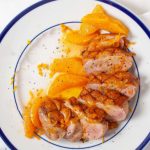 Sometimes the stars or, more accurately, the random contents of your fridge can lead you to unusual culinary destinations. I'm not sure if I had ever cooked duck breasts before. Duck legs often: a regular favourite and unbelievable value. So for a wee while, the pack of mallard breasts from Castle Game had lain untouched in the freezer.
Orange juice is seldom to be found in our house - just too much sugar even in the unsweetened stuff - but we had had the young 'uns visiting. And I'd just made some fresh chicken stock. I found a recipe which called for both. My improvisation (we had no fresh oranges in the house) worked terrifically well. With all due modesty, our Seville orange marmalade is wonderful stuff. In the early days I was simply L's gofer. Now it's probably fair to call it a 50:50 effort. As we don't eat huge amounts, our stock is acquiring vintage status. We'll return to that. Anyway, all the ... er, ingredients in a row.
Back to the protein. Cooking duck breast is completely counter intuitive. We are generally taught to start with a good sizzle in a nice hot pan. Not here. Duck breasts have a fairly thick layer of fat. Start hot and they'll be burnt before the flesh is cooked. Oh, but too cool and the fat won't render out. Tricky.
You'll note that I specifically mentioned mallard. Relatively small, with nowhere near the thickness of fat of a farmed bird. That, I'm afraid, is why I can't give you exact cooking times. Use your eyes and trust your judgement. At the foot, I've repeated suggested internal temperatures from the recipe. Fine if you have a food thermometer. (And if you don't, why not? You can get one for under a tenner.)
Duck Breast a l'Orange (serves 2)
Duck breasts - allow 150 - 200g per person. I had 4 small breasts in a pack; 120ml dry white wine; about 300ml chicken stock (have some extra in case you need it); 60g butter; 60ml orange juice; 1 - 2 tbsp bitter orange marmalade; s & p.
*************************************************
Season the breasts with salt, more heavily on the skin side. Use a solid frying pan. Put the duck breast side down in a cold pan. Turn the heat up to medium low. Have a fish slice or smaller pan or the like to press the breasts down if they start to curl up at the edges. You want to get them to a gentle bubble. Keep an eye on them. You want the outside to be golden and most of the fat rendered out. It will probably take about 15 minutes, but use your eyes, not a timer.
Pour off the excess fat from time to time. Retain for making roast potatoes. When the skin is brown, increase the heat to medium, flip over (the duck that is, not you) and cook for a minute or two. This will end your actual cooking of the beast, so check it's how you like it. It will go back into the pan just to meet up with the sauce and warm up.
Take the duck out and cover with foil. Deglaze the pan with the wine, scraping up all the flavoursome crispy bits. Let most of the wine evaporate until you have just a couple of tablespoons of liquid. Pour in the chicken stock and allow to reduce by about half. Then chuck in the orange juice and marmalade, stirring hard to incorporate everything and to get to the thickness you like. Season with s & p. Pop the duck back in for a minute or two to warm up and serve.
According to the recipe I found, internal temperatures should be as follows-
Medium rare - 54˚C
Medium - 60˚C
Well done - 68˚C