Cooking in Sri Lanka: Part 1 – Coconut
 Shining, resplendent island. That's Sri Lanka. Literally - it's what the name means in the Sinhalese language, the one spoken by the majority of people here. The other, should you be interested, is Tamil, possibly the oldest spoken language in the world. But I digress.
And in this lovely island, digress you will. Be entranced by its beauty of course, but I defy you not to become immersed in its fascinating history, its culture and, of course, its food.
We're just back after a couple of weeks travelling around. The trip included two cookery classes, a food tour and a lot of very good eating, as the waistline will attest. So much to pass on. The only question is, where to start. Although it uses the same spices as you find in India, Sri Lankan cuisine is quite distinct from, and lighter than, that of most Indian regions; however, as my new friend Netthu, who has recently started working in my local Sainsbury's, points out, it has definite similarities to what you will find in her native Kerala. If I were asked to sum up the difference in one word, it would be fairly simple. Coconut.
There is so much to this remarkable plant that, fairly soon, it will be included in the Food Alphabetical, even if we should be moving on to X,Y,Z. Fresh coconut is not readily available here, and that will give us some difficulty moving on. So too will our perceptions. Think shredded or desiccated coconut here, and we tend to think of cakes or sweets. Those of you who have used coconut milk from a tin may have raised your eyebrows at my assertion that dishes using it are lighter. The liquid you get is fairly viscous, and the tins are often topped with an almost solid gloop resembling thick cream.
Let's begin at our first class, at Kirinda Walauwa, the elegant bungalow of Lalith and Nirmala Illankoon at Gampola, just outside Kandy. Lalith is the third generation owner of this 75 acre spread, and has a distinctly patrician bearing. Over tea, he tells us proudly that he is about 75% self sufficient in food. The teak floor of his sitting room is so highly polished it could serve as a mirror. Traditional but expensive is the impression.
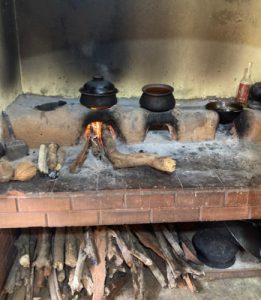
The kitchen therefore comes as a shock. A clay range with holes for four pots, fuelled by a wood fire under each. When the clay cracks, as it does from time to time, you repair it with cow dung. I wonder aloud whether this is just for the benefit of visitors. No, though there is an electric oven elsewhere for Prema's celebrated cakes. A grey haired lady with a twinkle in her eye, she has been with the family for 40 years. While Lalith and Nirmala may beg to differ, this kitchen is undoubtedly Prema's. She is quietly charming to everyone.
To everyone, perhaps, but not to coconuts. We are terrified by the ferocity with which she halves them with a mighty whack from a machete about half her size. And all the while the coconut is in her cupped hand. I take time to count her fingers. All, remarkably, seem to be intact.
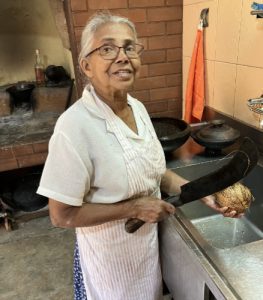
Prema
Fine, but how do you get your coconut milk? There's a device bolted to the bench, effectively a collection of serrated blades shaped like an orange squeezer. This is attached to a spindle with a handle on the end. Shove your coconut half in and turn the handle. Bob's your uncle? Well, not exactly. It's a long, slow, fiddly process. That white meat shows a distinct reluctance to be parted from its cosy coconut cocoon. And we have four to deal with that.
Eventually we have our nice white pile. What next? How do you convert that to our star ingredient? Prema pours water over it, then puts me in the hot seat. Take a handful of coconut and squeeze the liquid into a bowl. Each handful needs three squeezes. Repeat till all the flesh has been squeezed. Then more water is added to the coconut, and you do the whole thing all over again. Finished? Of course not. The first and second pressings give you the thicker milk. Once again the process is repeated, but into a separate bowl this time. That's the thinner milk. These two liquids are used at different stages in the cooking process. They bear little resemblance to anything you get from a tin, though I have discovered light coconut milk which is closer to the real thing.
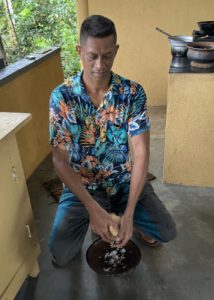
Cindy
I should say that the mechanical gizmo is quite posh. At our second course presided over by Douglas and Cindy (he's a he), we're using more traditional methods. There is a stool which resembles something used by a shoeshine boy. Instead of a metal plate to rest your foot on, there is a serrated shovel shaped blade round which you scrape your coconut. Viewed from a distance it looks rather rude.
So we have our coconut, and we have our coconut milk. What's next? A nap, obviously: but after that? Watch this space. We will renew the acquaintance of Prema, Douglas and Cindy very soon.
I’m enjoying this. Good to have you back.
Very kind, Wendy. Thank you.
Excellent Tom – leave ’em wanting more. I’m on tenter hooks.