Pizza At Home: Why Not?
Believe it or not, I do attempt to have some themes for these columns, some thought even. Today's inspiration went something like this. We have, in case you haven't noticed, been on a bit of a bread thing of late: a pizza base is basically bread dough: and with the Easter holidays not that far away, it's a fun thing to do with the kids.
They love playing with squishy stuff, but to get them interested you need a good end product. You and I may love the idea of a crunchy bit of sourdough slathered with good butter, but I bet that images of fresh pizza are more likely to entrance. Yes, you can get ready made pizza bases, or even balls of dough to roll out yourself, but that's hardly cooking, is it?
But it must be said that there are pitfalls. Let's start with making the base. You've seen the pizzaioli at work, haven't you? The cool looking guys who effortlessly achieve perfect consistency and shape by flinging the disc in the air and catching it before it hits the floor. Tip number 1. Don't Do It. You will end up with a dough hoopla up around your elbow, and look extremely foolish to boot. Nothing wrong with a rolling pin and a well floured or semolina-d surface.
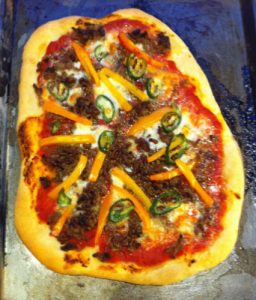
Who said they had to be round? With spicy mince, pepper and green chilli
Tip 2.1. Consider precisely where in your oven you're going to do the cooking. Do you have space? There's no law which states that pizzas must be round. No reason why you can't make a big square one and share it.
Tip 2.2. This is actually the biggest issue. You don't want a pizza that doesn't have a crispy base. Your oven probably has a maximum temperature of about 240˚C: a wood fired one in a professional kitchen will burn north of 425˚C. One answer is to buy a pizza stone, though I took the huff with mine. I assiduously followed the instructions on how to temper it, but at the first sight of action it broke in two. I got my money back and refused to get another. My most successful pizzas have been made on the back of a large baking tray. I don't have a completely flat baking sheet, and I didn't want a lip to prevent the pizza sliding off smoothly.
Tip 3. Give some thought to your toppings, and remember why the classics have passed the test of time. Yes, it's fun experimenting, but put the brain in gear. Are you using ingredients which will leak moisture? Consider what that will do to your nice crispy base. Likewise, if you overload your disc, the same fate will befall you.
Tip 4. You're starting with a traditional tomato and mozzarella base? Good for you. While your dough is proving, make the world's fastest and easiest tomato sauce. Take a tin of chopped tomatoes. Put in a saucepan with half a teaspoon of sugar and half a teaspoon of salt. Allow to bubble for a while until it thickens up. Allow to cool. Voilà! Or ecco! as the Italians would say.
Tip 5 (the last one I promise). Remember there are two types of mozzarella, though the packaging doesn't make that clear. The basic stuff, made from cow's milk, is technically known as fior de latte. When it melts it goes all stringy. Better by far to pay a bit more and go for buffalo mozzarella. (Yes, it really is made from buffalo milk.) When that melts it forms delectable little ponds of cheesy perfection.
Anyway, to business. The recipe is more or less the same as basic bread dough. It's just a little wetter to help the stretch.
Traditional Pizza Dough
Ingredients
500g strong white bread flour, plus extra for dusting; 10g salt; 10g fast action yeast; 4 tbsp olive oil, plus extra for oiling the surface and the bowl; 350 ml warm water; semolina flour for dusting.
********************************************
Mix the flour, yeast and salt in a baking bowl, making sure the yeast and salt don’t touch. (Salt will affect the yeast’s rising properties.) Add the oil and about half of the water, and mix well. I usually mix initially with a knife and get the hands in later. Purists will mix exclusively by hand. You could use a machine, but where’s the fun in that? Add the remaining water a bit at a time, till you have a smooth dough which has incorporated all of the flour. You may not need all of the water.
Tip onto an oiled surface and knead for about 10 minutes. Be warned, this is a slightly wet dough, which can make life a little tricky at the start of the kneading process. One of the best pieces of advice I ever read about bread making was that it's essential to show the dough who's boss. If your dough is being difficult, give it some welly. It’s ready when the dough is the consistency of Play Doh, and a finger indentation will slowly bounce back. Put in an oiled bowl, cover (to prevent a crust forming) and leave in a warm place until your dough has doubled in size. This will take at least a couple of hours, preferably more. Take the kids to the park to work up an appetite.
This will make enough for three typical size pizzas, but making more and smaller ones may be fun, as you can experiment more with toppings. Cut the dough into as many balls as you want, remembering Tip 2.1. Dust your surface with semolina. Knead each ball for another five minutes or so, then shape as you wish. It's best to do this on a board to help slide them into the hot oven. And if you have a pizza paddle, don't come bragging to me about it.
Preheat your oven with the stone or tray inside to 240˚C (or hotter if it will go higher).
Top your pizzas however you fancy. Drizzle with a little olive oil and bake. It's impossible to give you an accurate time as it will depend on the oven and the thickness of your dough. Allow anywhere between 5 and fifteen minutes. The crust should be slightly charred and the middle cooked through.