H is for Horseradish
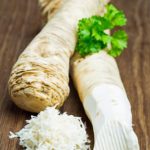 This week's inspiration was a blocked sinus. Not mine, but someone close. No problem, I said. Get hold of a horseradish root and grate it.
I don't know if you've ever made your own horseradish sauce, but it's not something you'd forget if you had. It's a root, as is its close cousin wasabi, and an unassuming one at that. You don't see it in the shops all that often. If you were to pick one up for the first time and sniff it, you would be forgiven for thinking you were being sold a dud. Almost odourless. Well, get rid of the outer layer, start grating and don't say you haven't been warned.
For the scientists among you, what is being produced is allyl isothiocyanate and it'll go right up your nose. That apparently is the plant's defence against herbivores. Highly effective. Despite the name, the plant is poisonous to horses, but vulnerable to cabbage worms. If you're thinking of planting your own, beware. The trick is to dig it out after the first frost, then replant one root for the following year. Leave it undisturbed and before too long there will be invasive underground roots everywhere.
It's been around for a very long time. Known in Egypt since 1500BC and extolled by the Delphic Oracle to Apollo. Who knew? In Pompeii there is a surviving mural which is thought to depict the plant. Its original use was for medical purposes. I suppose if a patient was threatened with having to sniff it, he'd make a pretty sharpish recovery. In the late 16th century in an English book entitled Herball, a writer named Gerard still referred to it as medicinal but commented that in Germany is was being mixed with vinegar and treated as a condiment in the same way that we were then (as now) using mustard.
It is more common in Europe than here, and is particularly important in some Jewish culinary traditions. I would always have it on the table when beef is being served, but I was surprised to read of it as an accompaniment to oysters. What a waste. I credit L with devising the idea of using a spoonful of the sauce to liven up a green soup.
I've looked up a recipe or two. In the States they commonly just mix it with mayo, which is fair enough. Vinegar is an essential mixing agent to preserve the flavour, and you can tone it down to your taste with cream or crème fraiche. I raised my eyebrows at the fact that most recipes call for a little mustard as well. Having said that, when stocks are low in Japan horseradish is sometimes used to make wasabi. Their name for it is seiyōwasabi or, sometimes, Western wasabi.
But before the recipe, have you ever paused to consider the name? Mighty odd and nothing to do with horses. Wikipedia suggests it has to do with a resemblance to horse genitalia. Unlikely. A more plausible explanation is the use of the prefix horse, to mean something bigger and coarser. Other examples include horse chestnut and horsemint. Another possibility surrounds a mistranslation from a German word, but that's too convoluted for today.
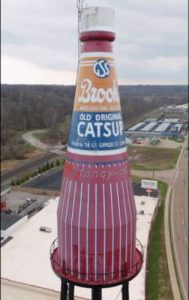
The Brooks Catsup Bottle, Collinsville
If you want to get really keen on today's hero, take yourself to Collinsville, Illinois. A major producing area, this town (population 24,366) has somehow acquired the title of Horseradish Capital of the World. There is an annual festival in the first weekend in June which features a 5K run, live music, a beauty pageant, and root-grinding demonstrations. The town is also home to a 170 feet tall water tower in the shape of a ketchup bottle. What's holding you back?
Horseradish Sauce
Grate a horseradish root about 6cm long. Mix with 2 tsp of vinegar (white wine or cider), 200ml of crème fraiche or sour cream (more if you want it milder) and 1 tsp Dijon mustard. Season with s & p to taste. Ideally leave in the fridge for a few hours before serving to let the flavours mingle.