F is for…Fennel
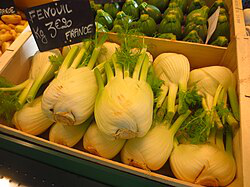 As we continue round 2 of the Tom's Food! Alphabetical, here's a question for you. What does today's hero have in common with the longest foot race in the Olympic Games? Read on to find out.
As you might expect, fennel is native to the shores of the Mediterranean. You wouldn't make a decent fish soup or bouillabaisse without a chunk or two flavouring your broth. You might not know that it's a member of the carrot family, though I suppose that the flowery leaves might be a bit of a giveaway. And you may be unaware that the type most commonly used is Italian, known as the Florence fennel. It was cultivated there in the 17th century, specifically to produce the large bulb or head with which we are familiar.
If you stop to think about it, this is a veg which is used in many ways and in all its forms. Those who like a strong aniseedy taste enjoy it raw in salads. While I'm not fond of pastis or Pernod (and I've never been brave/stupid enough to sample absinthe) I do like the milder flavour which you get after braising. The fronds are attractive and often used for garnish.
I was surprised to learn that some 60% of the world's crop comes from India. I've never knowingly eaten it there, but fennel seeds are among their most common spices. They also feature in the mix of Chinese five spice, the others being star anise, cinnamon, cloves and Sichuan pepper. Many countries will lay claim to making the world's finest sausages. I would certainly give Italy a podium place, the distinctive taste of fennel often being a feature.
More and more these days you will see menus of top chefs boasting of their use of fennel pollen. It's harvested from the flowers as you would expect and added as a finishing touch. I've never used it and I'm not sure I'd recognise it. Looking for descriptions I came on the following - ethereal, highly concentrated, and complex with strong notes of anise, citrus, honey, and warm warmth like saffron (as opposed to cool warmth, I suppose.) Or, having the same flavor notes as fennel seed, yet with a stronger citrusy essence and a sweeter, honey-esque quality. You get the picture. £825 a kilo.
Watching The Odyssey has us all looking back to mythological times, does it not? Remember poor Prometheus? He was the bloke whom the gods chained to a rock and had an eagle peck his liver out every day. His crime, you may recall, was stealing fire from the gods at Mount Olympus. But hands up if you knew that he carried the ember in a hollow fennel stalk. Until this morning, my hand would have stayed firmly down.
You wish some more names? In French fenuil, Old French fenoil. That's where we got it from. In Italian the word is finocchio. I know not where that came from. I only know that it's similar to ginocchio (knee) and that I once committed an embarrassing malapropism on an Italian plane, much to the amusement of the stewardesses.
It features in place names too. In Portuguese it's funcho. When settlers in Madeira were founding a new town, they noticed an abundance of the plants. The town? Funchal. And back to the question I posed at the beginning. A famous battle in Greek history took place on a plain festooned with fennel. They gave it the name of the plant, μάραθον, or, as we would know it, Marathon.