Y is for Yeast

The end product, obviously
Eukaryotic! A most splendid word. In my Italian classes we devised a Parola della Settimana (Word of the Week) competition. Were there to be an English equivalent, eukaryotic would be right in there. The biologists among you will be familiar with it. I was not, encountering it for the first time in my research about today's star ingredient.
Yeast is to be found everywhere: it has been used in food production for some 5000 years: very few of our households will not own something containing it. Yet a relatively small number of homes will have it as a separate ingredient. It's microscopic, which might cause you to confuse it with bacteria. Nay! It's eukaryotic. By that is meant that it contains quite complex cells having a nucleus, as do plants and indeed human beings.
In the 19th century, Louis Pasteur got to the bottom of things, developing our understanding of fermentation. Without any such comprehension, the ancient Egyptians had worked out how to use yeast. Evidence has been found of the manufacture of both leavened bread and beer as early as 3000 BC. Before Alfred Bird's invention in 1843, if you wanted some rise in your cakes, a bit of yeast was what you needed.
So why, with the exception of us home bakers, do so few store cupboards contain yeast? Well the good Mr Bird, after pioneering custard powder, invented baking powder as a raising agent. It needed a bit of further development by an American named Horsford, but it led to self raising flour, used by most cake makers up and down the land. As an aside, Bird's inspiration was his wife, who was allergic both to eggs and to yeast.
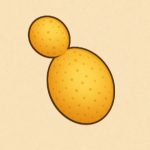
Not attractive, but you can't make bread without it
There are more than 1500 strains of yeast. You can't make leavened bread, or beer or whisky without it. In its most convenient form you can buy instant acting yeast. The purists, I believe, prefer fresh stuff. If you see a recipe calling for fresh yeast and want to use instant, half the quantity. Fresh is more volatile, and it can be difficult to know just how active it will become, even when you encourage it with warm water and sugar.
It's beyond the scope of this column to get into the science of the matter, but I find working with the stuff truly magical. The slow release of CO₂ which causes an uninspiring looking dough to double its size in a few short hours. Or the Quatermass-like expansion of a little sour dough starter when you feed it with simple flour and water, and leave it in the right conditions. Or, even more amazingly, the fact that, with just a little patience, you can create your own starter with only a few grapes, the yeast occurring naturally on the skins.
A life form indeed. And in a couple of years, I'll have to have a birthday party for Tony. He's my sourdough starter, who will be entitled to the key to the door on his 21st birthday. I really try not to get too precious about bread, but for me the journey began when I started to read the labels on the stuff you can buy in supermarkets. Even before the relatively recent noise about ultra processed food I was beginning to think, if I don't know what this is, do I really want to swallow it?
Although I've made about 99% of our bread for the past decade or so, I still have a long way to go. For an exciting project which is coming up in 2026 I have a good incentive to push my skills further. That will have to stay under wraps for now. I'll simply repeat the encouragement to you all. To those who haven't made bread from scratch; to those of you who haven't witnessed the miracle of your dough proving and proving again; to those of you who haven't savoured the brewery like aroma of a freshly fed sour dough starter, I say simply this. Try it. I'm sure you'll derive great satisfaction. And remember, you couldn't do it without Saccahromyces cerevisiae, baker's yeast.